The expression "Council of 9" offers diverse meanings according to context.
In ancient Greek mythology, it refers to a group of nine deities, encompassing the Olympian gods, who governed the cosmos and human life. Yet Ancient Greek texts never mention a factual ruling council of nine gods. The true rulers were the Twelve Olympians, who won power after defeating the Titans in a great war. Perhaps it was either Nine daughters of Zeus and Mnemosyne, each linked to a different art (like Calliope for epic poetry) who encouraged creativity but had no political power or nine mortal heroes (including Achilles) who judged souls after death in Plato’s Republic, that made an impact, not gods or Olympians at all. After all that, maybe it was the influence of the Heliopolitan Ennead (nine Egyptian gods) who ruled in Egyptian myth and the strong connection between Ancient Egypt and Greece that shaped the Greek stories.
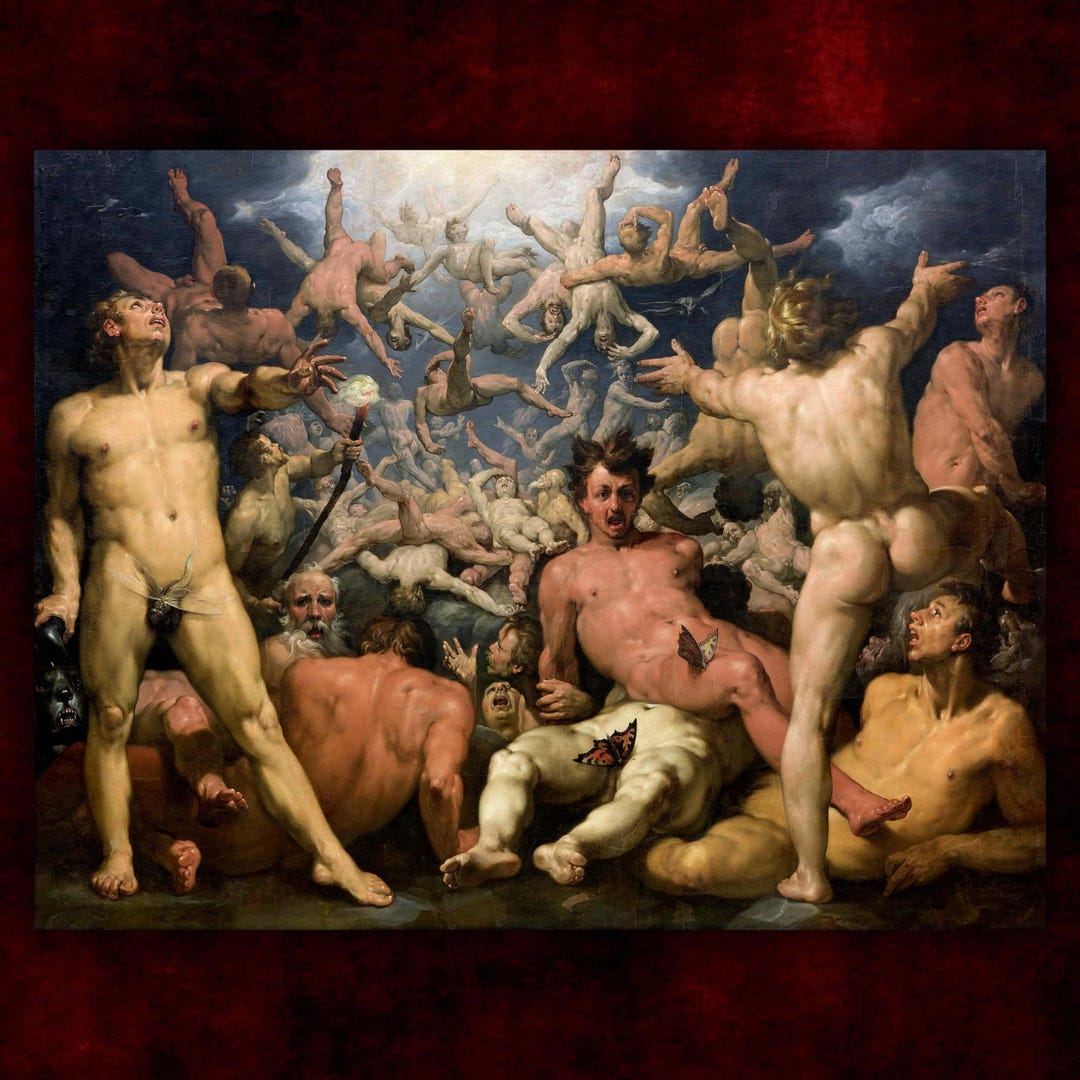
"The Fall of the Titans" by Dutch artist Cornelis Cornelisz Van Haarlem painted between 1588 and 1590 - Statens Museum (the national art gallery) in Copenhagen, Denmark.
In modern esoteric interpretations, a "Council of 9" is viewed as a council of elevated intelligence guiding humanity through high-energy transitions. The number nine is also prominent within numerology, symbolising completion, unity, and higher spiritual perspective.
In the context of the Satanic Church [dedicated to the religion of Satanism as defined by Anton Szandor LaVey], the term "Council of Nine" is used to refer to a group of nine individuals who are believed to be ancient galactic beings. They are said to intervene in and adjust the affairs of the world and in doing so guide humanity towards spiritual awakening and the new world.
The term "Council of 9" can also be associated with various other groups of nine in different cultures and mythologies, suggesting a recurring cosmic intelligence guiding humanity through the ages.


 👅👅👅👅👅👅👅👅👅 :eR